
Become a partner in regenerative equine medicine.
Offer your patients an innovative, autologous stem cell therapy—right in your practice. Simple, safe, and fully certified.
Why choose RegMed for your veterinary clinic?
Position yourself as an innovative hub for regenerative veterinary medicine.
Promoting Horse Health
Offer your patients access to regenerative medicine—using the body’s own cells, safe, and with long-lasting results.
Modern Practice Positioning
Establish your clinic as a modern, innovative center for cutting-edge veterinary medicine. Your work deserves recognition.
Developed with veterinarians – for veterinarians
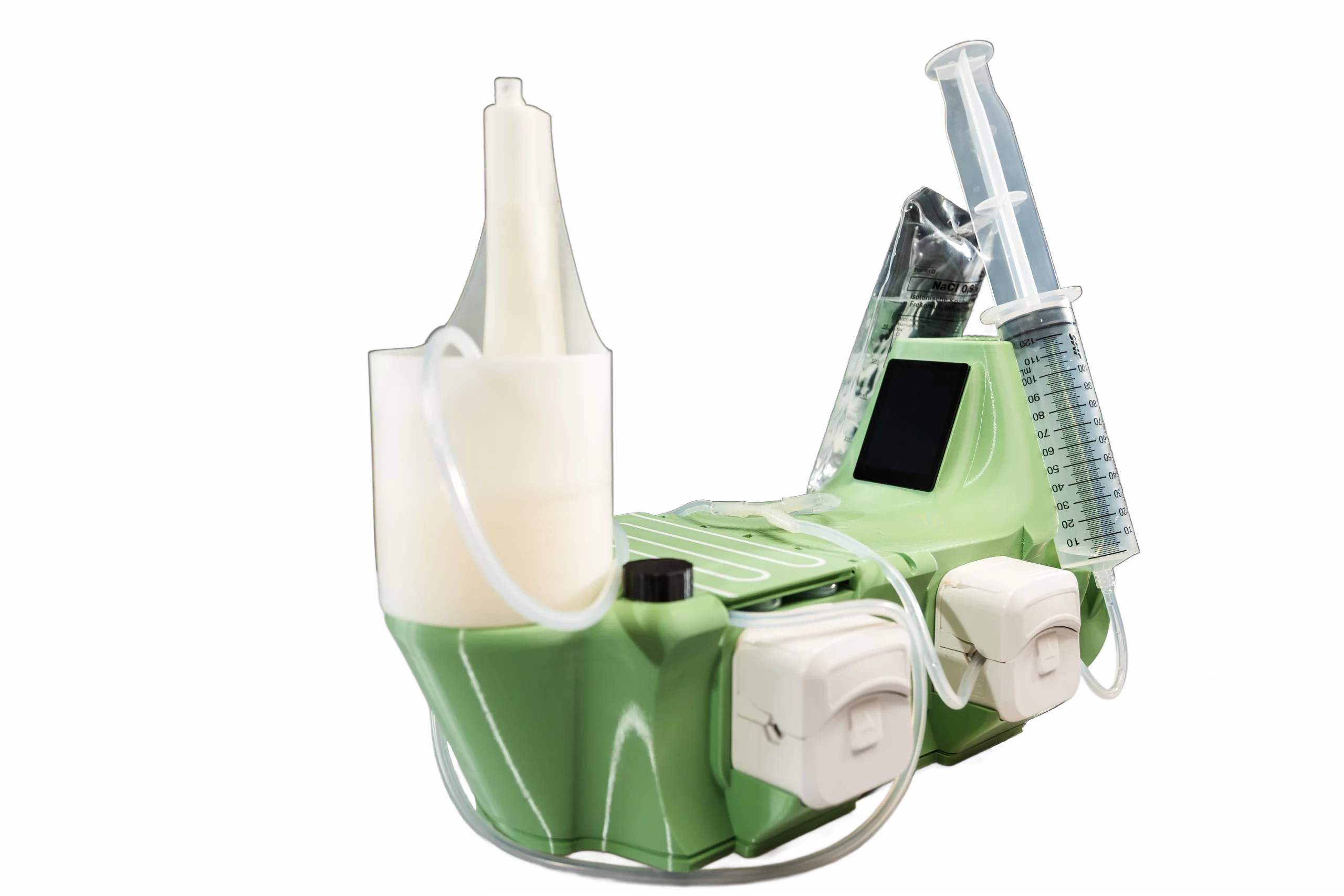
Designed from the ground up with the clinic in mind. No lab instruments, no bulky equipment, no unnecessary complexity. We’re constantly evolving, together with you.
Point-of-Care in 5 Minutes
No lab, no donor horse, no anesthesia. The cell preparation is completed on-site in under 5 minutes.
Indications – When Is the Therapy Suitable?
The concentrate can be administered intra-articularly, intralesionally, or locally in the area of the lesion – depending on the target structure.
Osteoarthritis / Degenerative Joint Disease
Suitable
- Mild to moderate OA (AAEP grade 1–3/5) with mild to moderate radiographic changes
- Early osteoarthritis after cartilage or subchondral injury as well as after arthroscopic fragment removal
- Post-traumatic synovitis with early degenerative changes
- Combination with PRP/IRAP, hyaluronic acid, or NSAIDs possible in moderate OA – especially as an alternative to repeated corticosteroid applications
- Advanced OA: as an adjunct to standard therapy for pain relief and slowing the process
Less suitable
End-stage OA with severe joint space narrowing, pronounced osteophytes, marked subchondral sclerosis, or mechanical instability; septic arthritis (except as an adjunct with aggressive antimicrobial and surgical treatment).
Tendon Injuries
Suitable
- Acute or subacute SDFT core lesion, preferably within the first 2–8 weeks after injury
- Mild to moderate lesions (<15–25% cross-sectional area) as well as moderate to severe lesions (25–50%) in performance horses with a high risk of reinjury
- Selected focal DDFT lesions as well as injuries of the accessory ligament/check ligament with a definable lesion on ultrasound
- Application intralesional under ultrasound guidance; ultrasound checks every 6–8 weeks mandatory
Less suitable
Complete tears, severe mechanical instability, lesions without an ultrasound-guided placement option, as well as lack of owner compliance for controlled rehabilitation.
Ligament Injuries
Suitable
- Proximal suspensory desmitis (front and hind legs), lesions of the medial or lateral branches of the suspensory ligament
- Collateral ligament injuries of the interphalangeal joints as well as of the fetlock or carpal joint with a definable lesion
- Acute and subacute cases preferred; selected chronic cases with active sonographic pathology possible
- For proximal suspensory desmitis: special care required due to proximity to neurovascular structures
Inflammatory Joint Diseases
Suitable
- Non-septic synovitis, recurrent inflammatory joint effusions, and early-stage degenerative joint disease with synovial inflammation
- Especially suitable where corticosteroids are contraindicated or should be minimized
- Possible as part of a multimodal protocol (hyaluronic acid, PRP/IRAP, controlled exercise, hoof correction)
- Infection must be ruled out before application
Postoperative Support / Recovery Promotion
Possible Indications
- After arthroscopic removal of cartilage debris in the presence of cartilage/synovial inflammation
- After tendon or ligament injuries, once the lesion is stable and clearly demarcated
- After focal soft tissue injuries in high-performance sport horses
- Selected cases after meniscal or soft tissue injuries in the stifle joint
- Treatment should be integrated into a written rehabilitation plan
Further Fields of Application
- Wound healing and athletic recovery in selected cases
- Performance support possible in compliance with legal requirements and after case-by-case review
Treatment Success & Scientific Basis
A large number of successfully conducted medical studies – both in human medicine and in veterinary medicine – underpin RegMed's treatment approach.
Individual Influencing Factors
The specific treatment success depends on a variety of influencing factors. Therefore, the assessment of success is always based on statistical statements – not in the sense of a guarantee for a specific horse.
- Biological age of the patient
- Quality and quantity of the cells extracted or injected
- Concentration of the stem cells
- Preservation of the habitat
- Genetic predisposition and pre-existing damage of the patient
Recovery Time & Costs
The recovery time is comparable to that of treatments that only relieve the symptoms.
The costs for a stem cell treatment with RegMed are within the usual range for comparable treatments.
Various financing options are available for financing the required machine.
Our long-standing consulting veterinarian and his internationally active veterinary clinic are already on board. Be one too!
Become a partner nowThe Biology Behind RegMed
The body's own stem cells from adipose tissue – scientifically founded, technologically precise, clinically proven.
more stem cells in adipose tissue than in bone marrow
That's why RegMed relies on adipose-derived stem cells (ADSC) – for higher concentration, gentler extraction, and maximum regenerative power.
Pluripotent ADSCs from SVF
The stromal vascular fraction (SVF) contains pluripotent autologous stem cells (ADSC) that can differentiate into almost all tissue types – cartilage, ligaments, muscle, connective tissue. RegMed builds on this finding.
Habitat Preserved – Risk Eliminated
RegMed obtains stem cells using purely fluid-mechanical methods – without enzymes, without foreign substances. The cells remain in their natural environment of messenger substances and accompanying cells, which completely eliminates immunological risks.
Patented Filter System
Processing takes place in a special silicone tube with a biodegradable, multi-stage filter system. The closed system is fully sterile and easy to use – directly at the point of care.
Why Adipose Tissue – Not Bone Marrow?
The extraction site determines cell quality, concentration, and patient burden. RegMed chooses the superior path.
- Lower stem cell concentration
- More invasive extraction, higher burden
- Anesthesia often required
- Up to 200× higher stem cell concentration
- Minimally invasive extraction at the tailhead
- Only sedation + local anesthesia required
General treatment procedure
8 clear steps – minimally invasive, fully on-site, without external laboratories.
Advantages over other methods
RegMed combines the highest process safety with maximum convenience – for you and your patients.
Point-of-Care Therapy
No external laboratory required.
- Treatment on-site at the point of care
- Highest hygienic process safety
- Simple operating concept
- Minimally invasive treatment
- Concentration completed in 5 minutes
- No anaesthesia required
- No laboratory required
- No donor horse required
- No enzymes required
- Lasting effect – targeting the root causes
- Sterility of all components
Become part of the evolution of equine health
As a partner, you contribute to promoting the well-being of all horses. The development is supported by continuous scientific accompaniment.
Prefer to call us directly?
Do you have questions about EquiCell?
Write to us directly – we respond personally and promptly.